AED Machine for Hospitals, Hotels & Workplaces | Health Point
Planning AEDs for multiple locations? Health Point supplies AEDs in bulk for hospitals, hotels, corporates, industries and institutions
Buy AED machines in bulk from Health Point for hospitals, hotels, workplaces, factories, gyms, schools and public facilities. Improve emergency preparedness with accessible AEDs.
A medical emergency can happen anywhere.
A guest may suddenly collapse in a hotel lobby.
An employee may suffer a cardiac arrest at work.
A visitor may collapse in a shopping centre, gym or sports facility.
A patient or attendant may experience a cardiac emergency in a healthcare facility.
In these situations, waiting for an ambulance or medical team may take valuable time.
This is why an Automated External Defibrillator (AED) can be an important part of emergency preparedness.
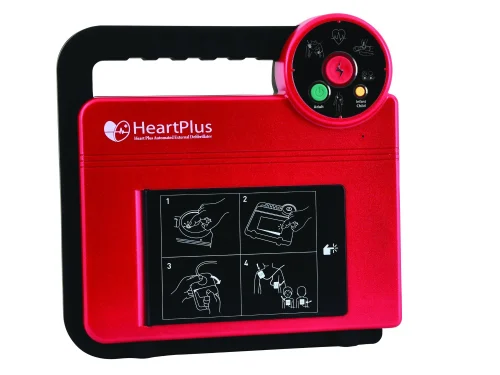
An AED is a portable medical device that analyses a person’s heart rhythm and, when appropriate, delivers an electrical shock to help restore an effective heart rhythm during certain types of sudden cardiac arrest. Modern AEDs provide step-by-step instructions to guide the responder through the process. Red Cross
At Health Point, AEDs are available for bulk purchase, making them suitable for hospitals, hotels, corporates, factories, institutions and other organisations looking to strengthen their emergency-response preparedness.
What Is an AED?
AED stands for Automated External Defibrillator.
It is designed for use during sudden cardiac arrest (SCA).
When a person experiences cardiac arrest, they may suddenly:
- Collapse
- Become unresponsive
- Stop breathing normally
- Breathe abnormally or only gasp
The American Heart Association recommends immediate action in suspected cardiac arrest: recognise the emergency, start CPR and use an AED as soon as possible. www.heart.org
An AED analyses the person’s heart rhythm and determines whether a shock is appropriate. It does not simply deliver a shock every time it is turned on. The device provides instructions and delivers a shock only when indicated by its analysis. Red Cross
Why Is an AED So Important?
The most important word in cardiac arrest response is time.
Cardiac arrest requires immediate treatment. CPR can help maintain circulation, while defibrillation may be required to address certain shockable heart rhythms.
The American Heart Association notes that the chance of survival decreases significantly when CPR and defibrillation are delayed. Its AED guidance cites a decline of approximately 7–10% in survival for every minute that passes without defibrillation. international.heart.org
That is why simply having an AED somewhere in a city is not the same as having an AED near the people who may need it.
An AED needs to be:
Available → Accessible → Clearly identified → Maintained → Supported by an emergency-response plan
The goal is to reduce the time between collapse and the beginning of appropriate emergency care.
AED + CPR: Part of the Chain of Survival
An AED should not be considered a replacement for CPR or emergency medical services.
It is one part of a broader emergency response.
A typical response to suspected cardiac arrest involves:
1. Recognise the emergency
The person is unresponsive and not breathing normally or is only gasping.
2. Activate emergency medical help
Call the local emergency medical service and ask someone to bring the AED.
3. Start CPR
Begin CPR according to your level of training.
4. Use the AED as soon as it arrives
Turn it on and follow the device’s voice or visual instructions.
5. Continue care
Follow the AED prompts and continue CPR as instructed until professional medical help takes over.
The American Red Cross similarly recommends getting an AED as soon as possible, turning it on, following its prompts and continuing CPR after a shock or when no shock is advised. Red Cross
Why Every Hospital Should Have Accessible AEDs
Hospitals already have advanced resuscitation equipment and trained medical professionals.
So why discuss AED availability?
Because speed and accessibility still matter.
A large hospital may have:
- Multiple floors
- Emergency departments
- OPDs
- Waiting areas
- Corridors
- Cafeterias
- Parking areas
- Staff areas
- Diagnostic centres
- Visitor areas
An AED programme can therefore be considered as part of the facility’s broader emergency-response planning, with equipment positioned according to the facility layout, risk assessment and response plan.
Hospitals may also require different types of defibrillation equipment depending on the clinical environment. An AED should not automatically be considered a replacement for the professional defibrillation equipment used by trained clinical teams.
Why Hotels & Hospitality Businesses Should Consider AEDs
The hospitality industry is particularly interesting because hotels bring together large numbers of people from different age groups and backgrounds.
A hotel may have:
- Guests
- Staff
- Restaurant customers
- Conference attendees
- Wedding guests
- Visitors
- Contractors
- Vendors
- Event participants
A cardiac emergency could occur in:
- Hotel lobby
- Restaurant
- Banquet hall
- Conference room
- Gym
- Swimming pool area
- Parking area
- Guest floor
For a hotel, having an AED in an accessible location can become part of its broader guest and workplace emergency preparedness programme.
The American Red Cross notes that AEDs are commonly placed in locations where many people gather and recommends accessibility, awareness and CPR/AED training as components of preparedness. Red Cross
For hospitality businesses, the question should not simply be:
“Do we have an AED?”
It should be:
“If a cardiac emergency happens here, can our team get an AED to the person quickly?”
That is a much more useful way to think about AED placement.
AEDs in Corporate Offices & Workplaces
A workplace can have hundreds or thousands of employees and visitors.
Cardiac emergencies are not limited to people who already have a known heart condition.
For this reason, AED programmes can be relevant across many workplace environments, including:
- Corporate offices
- IT companies
- BPOs
- Manufacturing units
- Warehouses
- Industrial facilities
- Construction sites
- Educational institutions
- Research facilities
- Large commercial establishments
The American Heart Association encourages organisations to implement AED programmes as part of preparedness for cardiac emergencies. cpr.heart.org
For larger organisations, multiple AEDs may be appropriate depending on the size and layout of the premises and the time required to retrieve an AED.
AEDs for Gyms, Fitness Centres & Sports Facilities
Physical activity environments are another setting where emergency preparedness deserves attention.
AEDs can be considered for:
- Gyms
- Fitness centres
- Sports clubs
- Swimming facilities
- Stadiums
- Recreation centres
- Sports academies
These facilities may have large numbers of people participating in physical activity, often in different areas of a large premises.
Having an AED nearby, combined with trained staff and an emergency response plan, can improve preparedness for sudden cardiac emergencies.
AEDs for Schools, Colleges & Educational Institutions
Educational institutions can also consider AED programmes as part of their emergency preparedness.
Schools and colleges may have:
- Students
- Teachers
- Administrative staff
- Visitors
- Sports facilities
- Large gathering areas
- Events and competitions
AED placement should be based on the institution’s layout, emergency response plan and applicable requirements.
Importantly, organisations should ensure that their AED programme considers appropriate equipment, training and procedures for the population they serve, including children where relevant.
AEDs for Factories & Industrial Facilities
Industrial environments often focus heavily on workplace safety — PPE, fire safety, first aid, emergency exits and accident prevention.
Emergency preparedness can also include planning for medical emergencies such as sudden cardiac arrest.
AEDs may be considered for:
- Manufacturing plants
- Factories
- Warehouses
- Industrial estates
- Large workshops
- Power and utility facilities
- Large production facilities
For large premises, placement matters.
An AED locked away in an office several hundred metres from a production area may not provide the same practical accessibility as an AED positioned according to a properly planned emergency-response system.
AEDs for Malls, Airports, Stations & Public Spaces
AEDs are increasingly associated with public-access defibrillation.
They may be found in locations such as:
- Airports
- Railway stations
- Shopping centres
- Convention centres
- Public buildings
- Large event venues
- Community centres
- Recreation facilities
The American Red Cross identifies many such high-footfall environments as places where AEDs may be located. Red Cross
The underlying principle is simple:
The closer the AED is to the emergency, the less time may be lost retrieving it.
Where Should an AED Be Placed?
There isn’t one universal location that works for every building.
Placement should be determined by the organisation’s emergency-response plan and the layout of the premises.
However, an AED should generally be:
- Easy to find
- Clearly marked
- Accessible during operating hours
- Located where people know to look
- Protected from inappropriate environmental conditions
- Regularly checked
- Integrated into the organisation’s emergency response procedure
Common locations may include:
Reception areas | Security desks | Main entrances | High-traffic areas | Gym areas | Sports facilities | Large gathering areas
For larger premises, more than one AED may be appropriate.
Buying an AED Is Not the Same as Having an AED Programme
This is an important distinction.
An organisation should not simply purchase an AED, put it in a cupboard and forget about it.
A useful AED programme should consider:
AED placement
Where is it located?
Accessibility
Can someone reach it quickly?
Signage
Can employees and visitors identify it?
Training
Do designated staff know how to respond?
Maintenance
Are the device, batteries, pads and other required components within their usable period and ready for service?
Emergency procedures
Who calls emergency services?
Who retrieves the AED?
Who begins CPR?
Who meets the ambulance?
Documentation
Is the AED being checked and maintained according to the manufacturer’s requirements and the organisation’s procedures?
The Red Cross also describes AED programmes as involving more than simply purchasing a device, including placement, implementation, training and replacement accessories. Red Cross
Can an Untrained Person Use an AED?
AEDs are designed to guide the responder through the process, and organisations should provide appropriate CPR/AED training.
The American Red Cross states that formal training is recommended, but a person should not hesitate to use an AED during an emergency simply because they have not completed formal training; the device provides instructions. Red Cross
In an actual emergency:
Call emergency services, begin CPR when appropriate, retrieve the AED and follow its instructions.
Training, however, can make people more confident and prepared to respond.
AED vs Manual Defibrillator: Are They the Same?
No.
A manual defibrillator is generally operated by trained healthcare professionals who interpret the patient’s cardiac rhythm and determine the appropriate intervention.
An AED automatically analyses the heart rhythm and provides instructions about whether a shock is indicated.
This makes AEDs particularly useful for rapid response outside highly controlled clinical environments, including workplaces and public spaces.
The appropriate device depends on the environment, users and clinical requirements.
How Health Point Can Help With Bulk AED Requirements
At Health Point, we provide AED solutions for organisations looking to equip their facilities with emergency-response equipment.
Our AED supply is particularly suitable for bulk requirements, including:
- Hospitals
- Hotels
- Hotel chains
- Corporate offices
- Factories
- Manufacturing units
- Schools and colleges
- Gyms and fitness centres
- Sports facilities
- Malls and commercial establishments
- Event venues
- Nursing homes
- Large institutions
- Public-facing facilities
If an organisation is planning to equip multiple locations, Health Point can discuss the quantity, intended environment and procurement requirements.
For multi-site organisations, bulk procurement can also allow the organisation to standardise its AED deployment rather than purchasing individual units for each location without an overall plan.
Why Bulk AED Procurement Makes Sense for Large Organisations
For a single small facility, one AED may be sufficient depending on its layout and emergency plan.
But large organisations may have multiple:
- Buildings
- Floors
- Branches
- Hotels
- Manufacturing facilities
- Campuses
- Offices
- Public areas
In such cases, AED procurement can become an organisation-wide safety initiative.
For example:
Hotel Group
One AED at each participating hotel, with standardised training and maintenance procedures.
Corporate Group
AEDs across multiple offices and campuses.
Hospital Network
AEDs positioned across appropriate non-clinical/public areas alongside the hospital’s existing emergency equipment.
Manufacturing Company
AEDs distributed across large production facilities according to site-specific emergency planning.
Educational Group
AEDs across multiple schools, colleges or campuses.
An AED Is Not Just Another Medical Device
An AED may spend most of its life sitting quietly in a cabinet.
That does not mean it is unnecessary.
A fire extinguisher may sit unused for years.
A first-aid kit may remain untouched for months.
Emergency equipment is purchased because we cannot predict exactly when it will be needed.
The same principle applies to an AED.
Its value is not measured by how frequently it is used.
Its value is in being available when a cardiac emergency occurs.
AED + First Aid Kit: A More Complete Emergency Preparedness Approach
Health Point’s growing safety portfolio includes First Aid Kits, Safety Kits, Burn Care Kits and AEDs.
These products address different emergency requirements.
| Emergency Preparedness | Purpose |
|---|---|
| First Aid Kit | Basic first-aid supplies |
| Burn Care Kit | Initial burn-care supplies |
| Safety Kit | Workplace/emergency preparedness |
| AED | Emergency response for certain sudden cardiac arrests |
Together with appropriate training, emergency procedures and professional medical support, these can form part of a broader organisational safety programme.
Don’t Ask Only “Do We Have an AED?”
Ask:
Can someone find it quickly?
Can someone bring it to the patient quickly?
Does the staff know what to do?
Is the AED maintained and ready?
Is CPR/AED training available to appropriate personnel?
Is the emergency response plan clear?
Because an AED is most valuable when the device, the people and the emergency-response system work together.
Buy AEDs in Bulk from Health Point
Health Point supplies AEDs for bulk purchase for hospitals, hotels, corporates, industries, institutions and other organisations.
If you are planning to equip:
- One facility
- Multiple branches
- A hotel group
- A hospital network
- Corporate offices
- Industrial facilities
- Schools or colleges
- Gyms or sports facilities
- Large public-facing premises
Talk to Health Point about your bulk AED requirement.
We can discuss your application and procurement requirement so that you can plan your AED deployment appropriately.
Health Point — Medical Equipment & Emergency Preparedness Solutions
Frequently Asked Questions
What does AED stand for?
AED stands for Automated External Defibrillator.
What is an AED used for?
An AED is used during sudden cardiac arrest. It analyses the heart rhythm and delivers a shock when indicated to help restore an effective heart rhythm. Red Cross
Can an AED be used outside a hospital?
Yes. AEDs are specifically designed to support rapid response to sudden cardiac arrest outside traditional clinical settings and are used in workplaces and public locations. Red Cross
Should hotels have AEDs?
Hotels can consider AEDs as part of their emergency preparedness because they accommodate guests, staff and visitors across multiple areas. Placement should be based on the hotel’s emergency-response plan, layout and applicable requirements.
Should factories and industrial workplaces have AEDs?
Organisations can consider AEDs as part of their workplace emergency-response planning, particularly where large numbers of employees work across extensive premises.
Does an AED replace CPR?
No. CPR and rapid defibrillation are complementary parts of cardiac-arrest response. www.heart.org
Does an AED shock everyone?
No. An AED analyses the heart rhythm and provides a shock only when its analysis determines that a shock is appropriate. Red Cross
Does Health Point supply AEDs in bulk?
Yes. Health Point supplies AEDs for bulk procurement for hospitals, hotels, corporates, industries, institutions and other organisations.
Does an organisation need training along with an AED?
Appropriate CPR/AED training is strongly recommended. An organisation should also establish clear emergency procedures and ensure the AED is maintained according to the manufacturer’s requirements.